



Stefan G Stanciu, Radu Hristu, George A Stanciu, Denis E Tranca, Lucian Eftimie, Adrian Dumitru, Mariana Costache, Harald A Stenmark, Harm Manders, Amit Cherian, Mariliis Tark-Dame, Erik M M Manders | Proc Natl Acad Sci U S A 2022 Nov 22;119(47):e2214662119
Summary
Second harmonic generation microscopy (SHG) is a powerful label-free technique for three-dimensional imaging of biological tissues and advanced materials, widely used for collagen visualization. However, progress in super-resolved SHG imaging has lagged behind fluorescence-based nanoscopy methods.
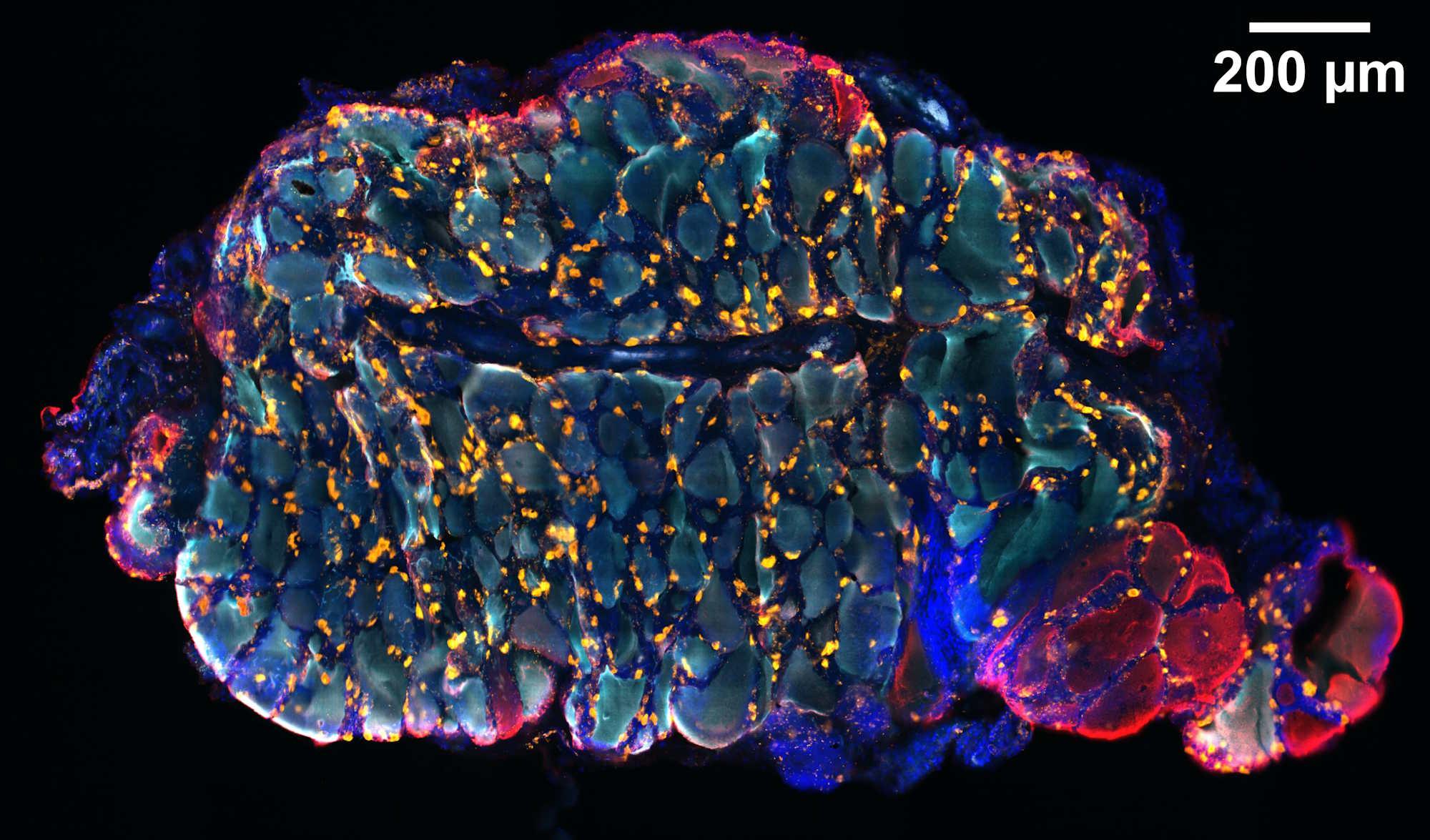
In this study, the authors demonstrated super-resolved REscan SHG microscopy and showed that it provides resolution improvements beyond the conventional diffraction limit in collagen-rich tissues.
They also introduced super-resolved REscan two-photon excited fluorescence microscopy, extending REscan imaging principles to another nonlinear optical modality.
These findings highlight new opportunities for high-resolution label-free and multiphoton imaging in biological and materials research.
Read the publication: https://pubmed.ncbi.nlm.nih.gov/36375085
Why REscan for this study
Second harmonic generation (SHG) microscopy images collagen and other structures without any fluorescent labels, but its resolution is limited by diffraction, so fine details stay blurred. REscan microscopy, the principle behind our RCM and REscan confocal systems, overcomes this by re-scanning the signal onto a camera. Applying it to SHG gave sharper images of collagen-rich tissue, beyond the diffraction limit. The authors then used the same approach for two-photon excited fluorescence, showing that re-scanning can improve resolution in other multiphoton imaging techniques as well.