




There are 3 types of confocal technologies
1967 Spinning Disks (SD), where an image from many pinholes is projected on the camera as a detector
1969 Laser Scanning Confocal Microscopes (LSCM) with, usually, a PMT detector directly after one pinhole
2016 REscan confocals, with an additional scanning optical system between the pinhole and the camera detection (see PART 1)
Comparison of confocal technologies
Based on advantages in different applications:
Line REscan is comparable to SD
Point REscan is comparable to LSCM+SR add-on
| Low phototox. | Fast imaging | Deep imaging | Super Resolution (SR) | |
|---|---|---|---|---|
| SD | ✓ | ✓ | ✓ | ✗ |
| SD+SR add-on | ✓ | ✓ | ✗ | ✓ |
| LSCM | ✗ | ✗ | ✗ | ✗ |
| LSCM+SR add-on | ✗ | ✗ | ✗ | ✓ |
| Point REscan | ✓ | ✗ | ✓ | ✓ |
| Line REscan | ✓ | ✓ | ✓ | ✗ |
Line REscan vs Point REscan: Confocality
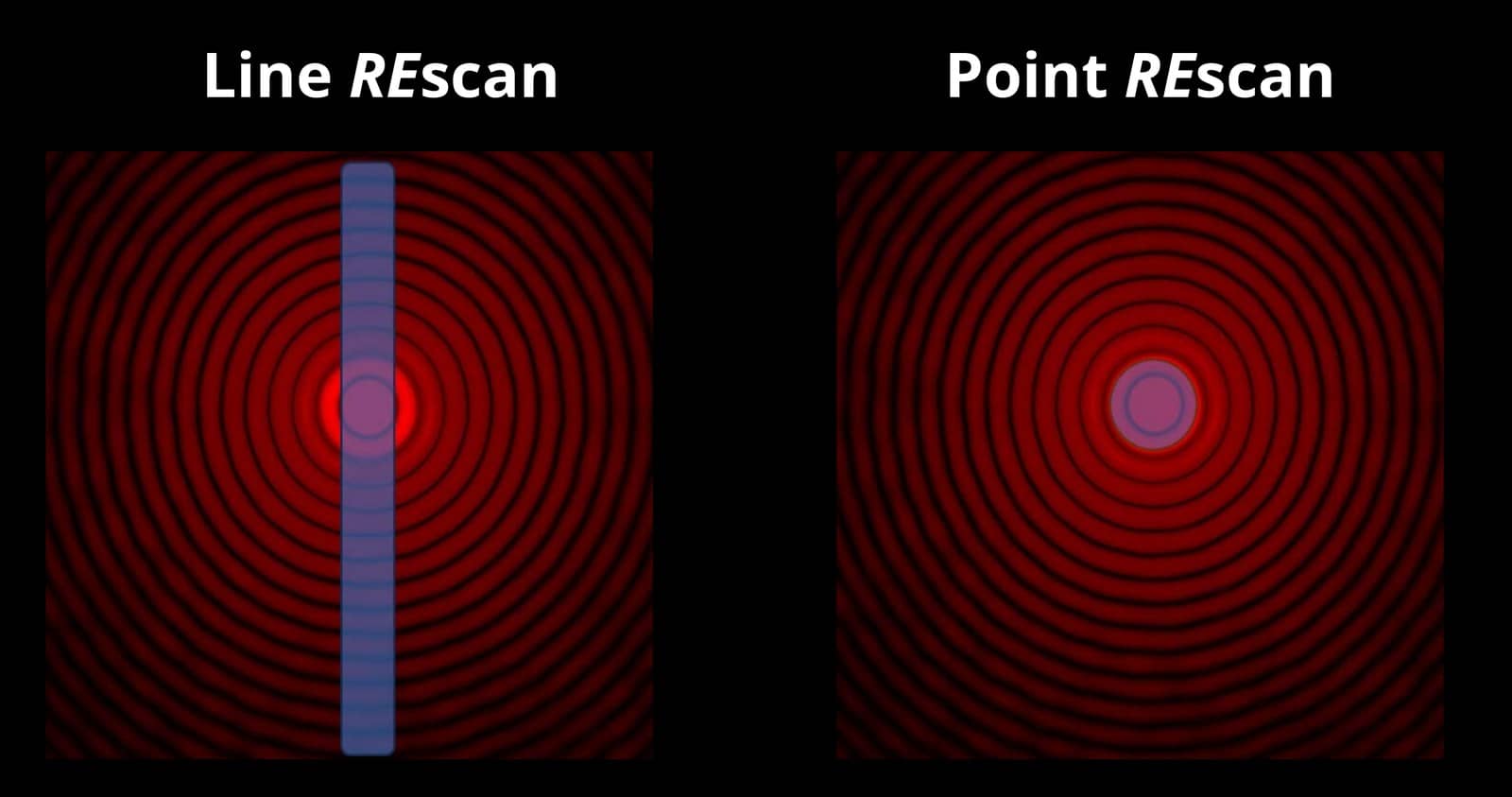
In Line REscan, compared to Point REscan, we have consciously sacrificed a fraction of confocality to gain a tremendous improvement in speed (similar to confocality/speed in SD vs LSCM, respectively).
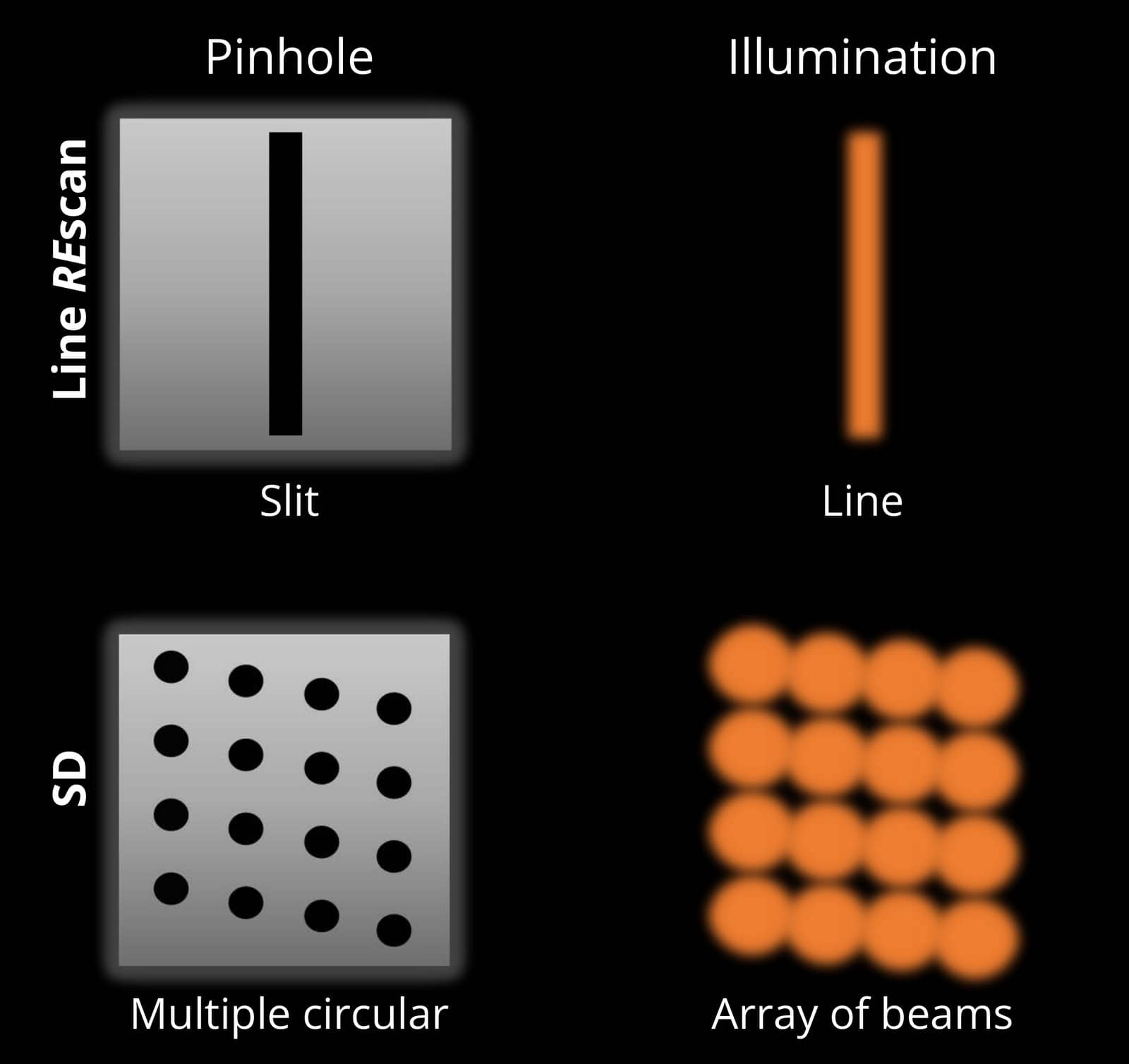
Line REscan vs Spinning Disk: Pinhole
Line REscan and Spinning Disk (SD) block out-of-focus light in different ways.
Line REscan uses a slit as its pinhole, with line illumination.
SD uses multiple circular pinholes, with an array of beams.
Line REscan vs Spinning Disk: Confocality
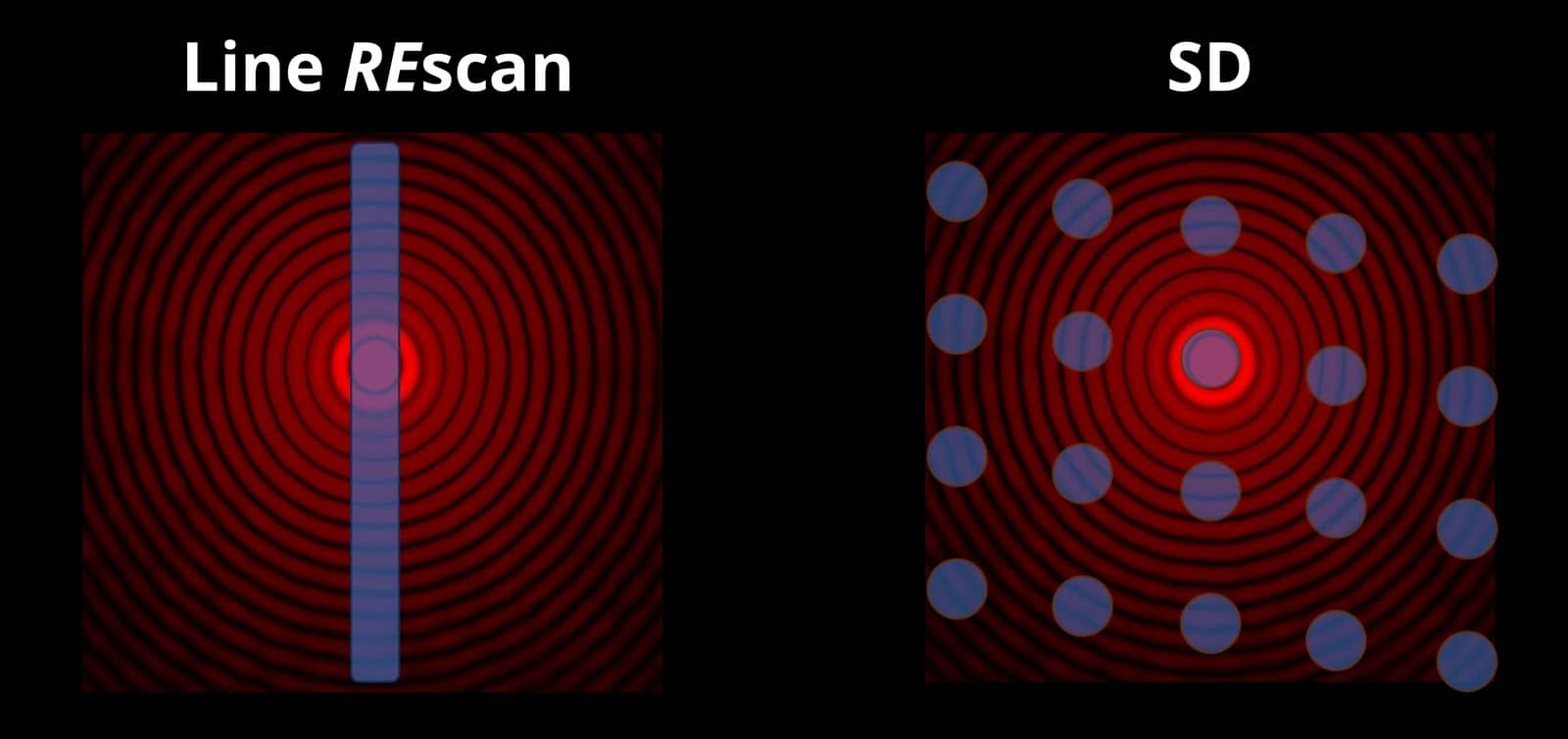
Line REscan and SD have reduced confocality compared to Point REscan or LSCM.
With more depth, the crosstalk of many pinholes is evident in SD but not in Line REscan, making the latter superior for deep imaging.
Advantages of Point REscan compared to LSCM+SR add-on?
1. Lower phototoxicity,
2. Brighter signal,
3. Deeper imaging, all three due to:
a) higher sensitivity of the detector
b) larger pinhole (see Quick Knowledge Part 1)
4. Optically fixed super resolution
(no processing necessary)
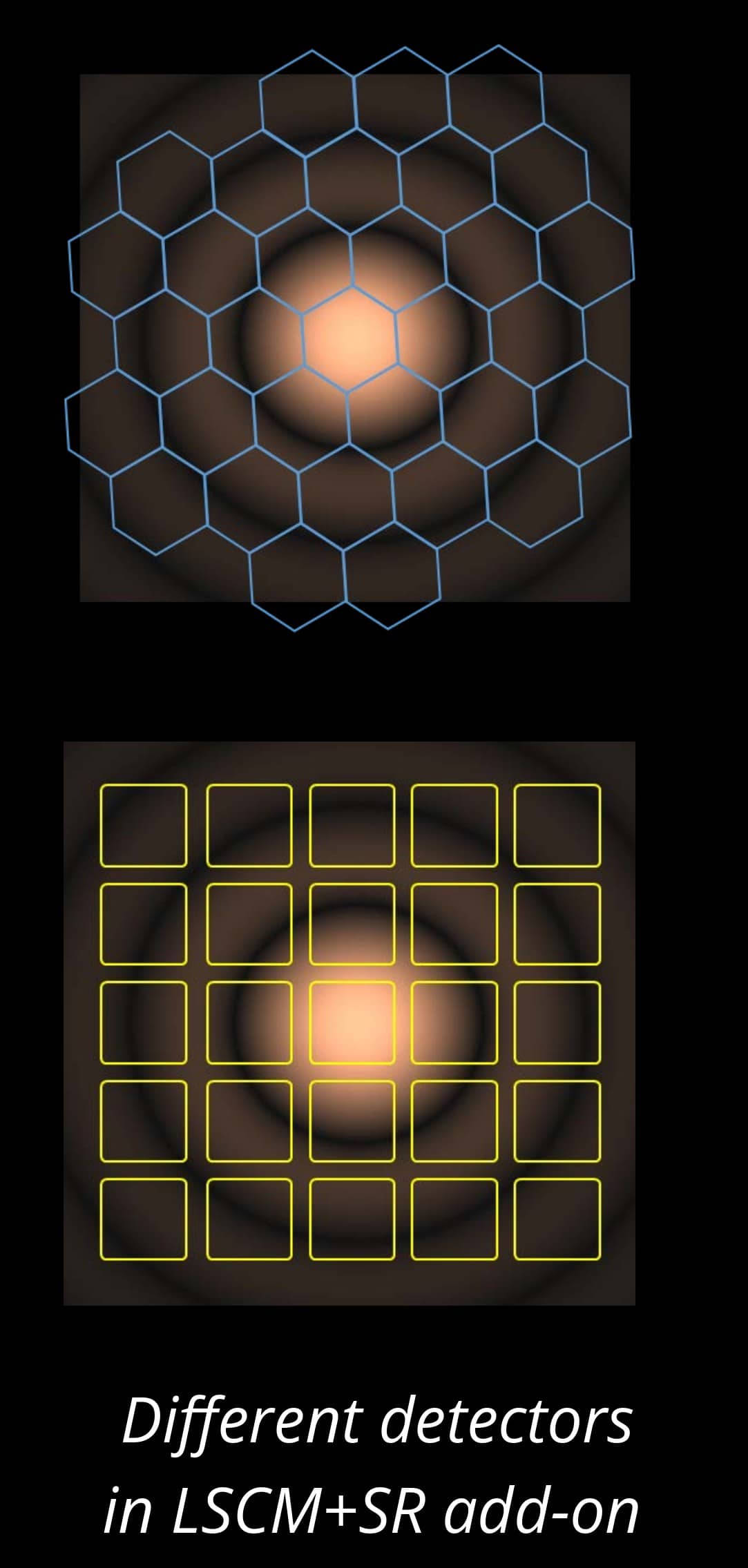
Comparing REscans to corresponding confocals
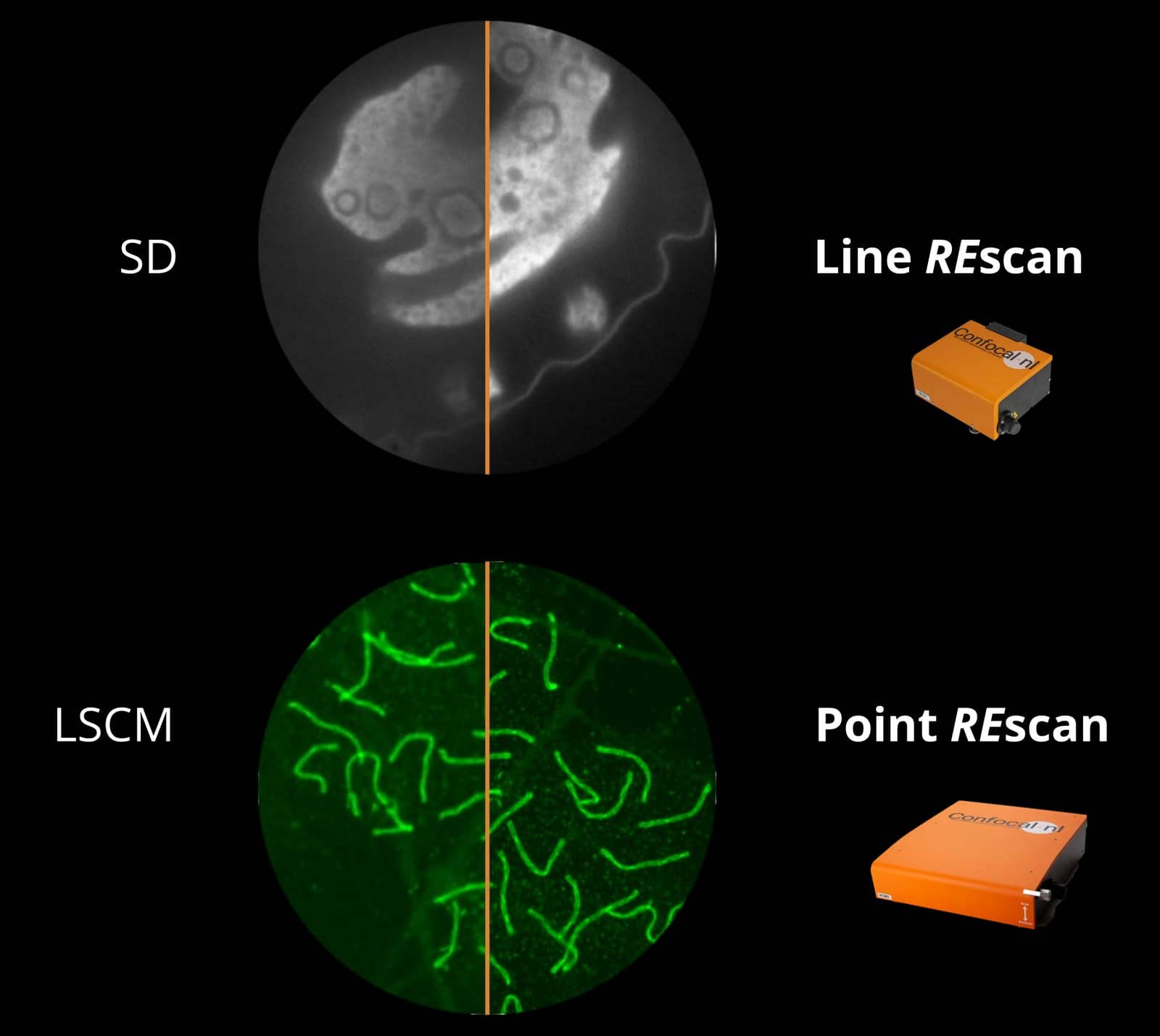
Each REscan has a corresponding confocal.
Line REscan corresponds to the Spinning Disk (SD).
Point REscan corresponds to the Laser Scanning Confocal Microscope (LSCM).
Download the quick knowledge
Receive more information about this knowledge article.