



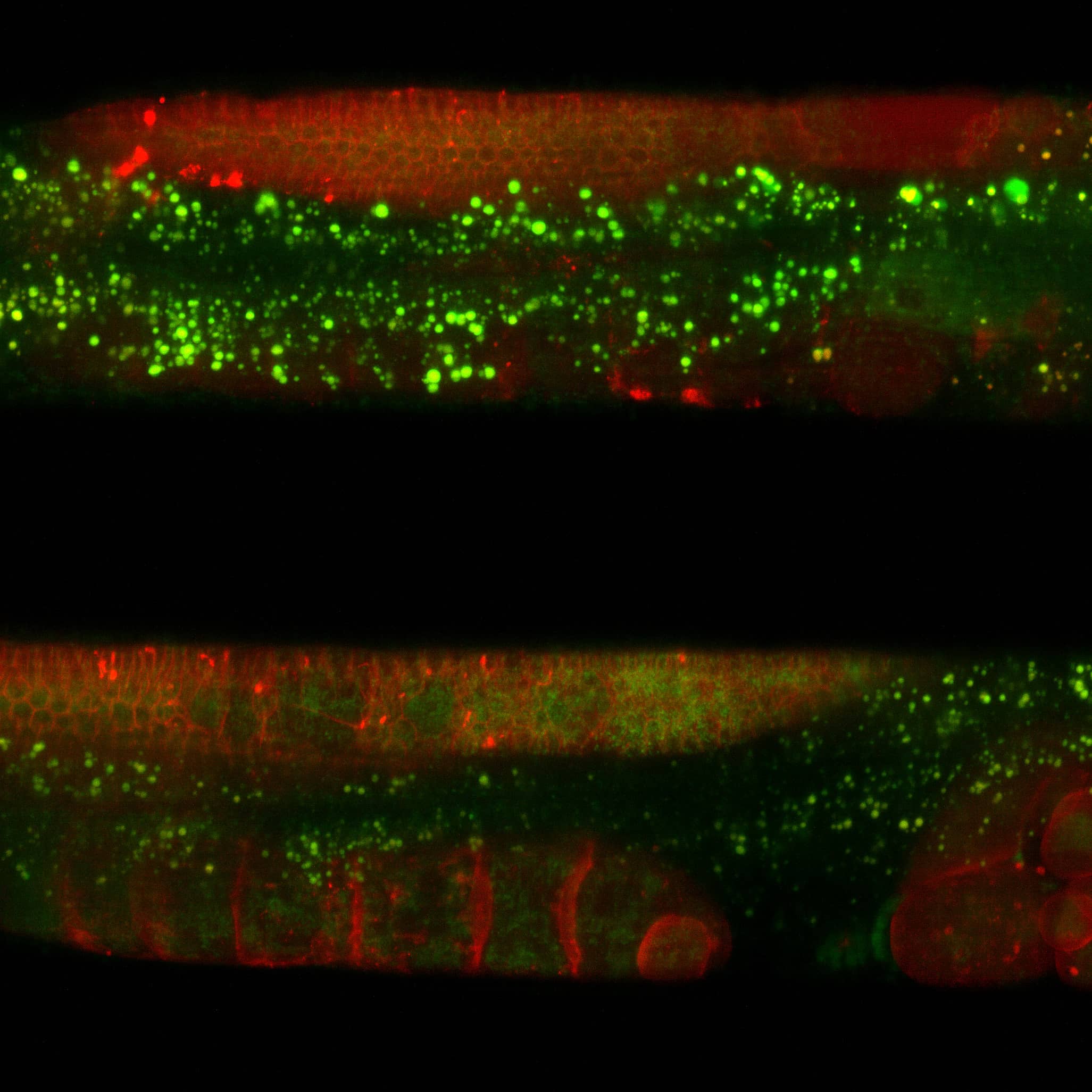
The larval zebrafish serves as a powerful model for studying neural circuit development due to its transparency and suitability for fluorescent microscopy. Using the GAIA Point REscan confocal microscope, we performed Super resolution imaging to investigate the structural and functional development of the zebrafish nervous system between three and five days post-fertilization. GAIA Point REscan facilitated extended imaging sessions with minimal phototoxicity, offering new insights into vertebrate neural development. Imaging revealed key features, such as synaptic boutons and axonal projections, critical for circuit formation. Combining Super resolution structural imaging with functional assays enabled the dynamic tracking of neural rewiring.
Why GAIA for this study
Tracking a developing nervous system over several days requires repeatedly exposing the same larvae to laser light, which can damage the structures you want to study. GAIA Point REscan produces Super resolution images with very little light, so researchers could image larvae in extended sessions from three to five days post-fertilisation with minimal phototoxicity. This made it possible to resolve fine structures such as synaptic boutons and axonal projections, and to combine structural imaging with functional assays to follow how neural circuits rewire as they form.
Download the application note
Learn more about this application.