



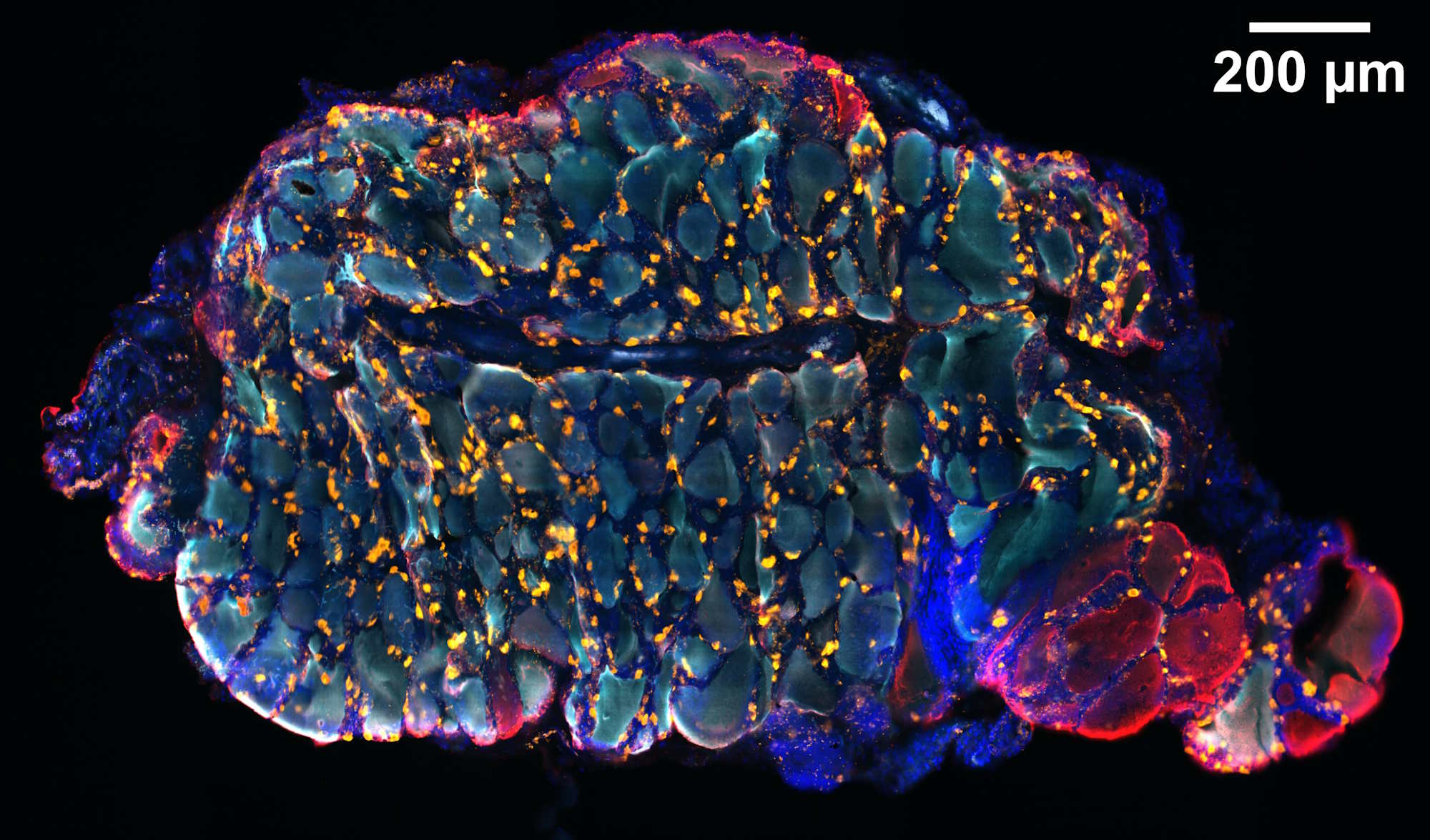
Jabermoradi, A., Yang, S., Gobes, M., van Duynhoven, J. P., & Hohlbein, J. (2021) | Phil. Trans. R. Soc. A. 380: 20200164.
Summary
Turbidity is a major challenge in microscopic analysis of many food systems, as refractive index variations cause reflection, absorption, and scattering that degrade image quality with depth.
In this study, the authors combined adaptive optics (AO) with single-molecule localization microscopy (SMLM) to improve imaging resolution. Using the open-hardware miCube platform, they added a deformable mirror for aberration correction and 3D SMLM imaging, together with a top-hat beam shaper for more uniform illumination.
As a model system, they examined an oil-in-water emulsion containing phosvitin at the oil-water interface. Fluorescent antibodies and PSF engineering enabled 2D and 3D imaging of oil droplets with resolution below 100 nm.
The system resolved droplets as small as 200 nm, beyond conventional confocal microscopy, and showed that phosvitin was evenly distributed at the interface.
These findings demonstrate new possibilities for super-resolved imaging in complex food emulsions.
Read the publication: https://doi.org/10.1101/2021.03.03.433739